

Ring Of The Nibelungs Watch Online
| Der Band des Nibelungen | |
|---|---|
| Music dramas by Richard Wagner | |
 Scene ane of Das Rheingold from the get-go Bayreuth Festival production of the Bühnenfestspiel in 1876 | |
| Translation | The Ring of the Nibelung |
| Librettist | Richard Wagner |
| Language | German |
| Premiere |
Bayreuth Festspielhaus |
Der Ring des Nibelungen ( The Ring of the Nibelung ), WWV 86, is a bike of four German-language epic music dramas composed by Richard Wagner. The works are based loosely on characters from Germanic heroic legend, namely Norse legendary sagas and the Nibelungenlied. The composer termed the wheel a "Bühnenfestspiel" (stage festival play), structured in three days preceded past a Vorabend ("preliminary evening"). It is ofttimes referred to as the Ring cycle, Wagner's Band , or merely The Ring .
Wagner wrote the libretto and music over the form of nigh twenty-six years, from 1848 to 1874. The four parts that plant the Ring cycle are, in sequence:
- Das Rheingold (The Rhinegold)
- Die Walküre (The Valkyrie)
- Siegfried
- Götterdämmerung (Twilight of the Gods)
Individual works of the sequence are often performed separately,[1] and indeed the operas contain dialogues that mention events in the previous operas, so that a viewer could watch any of them without having watched the previous parts and nevertheless understand the plot. Even so, Wagner intended them to be performed in series. The commencement performance as a bicycle opened the showtime Bayreuth Festival in 1876, beginning with Das Rheingold on 13 August and ending with Götterdämmerung on 17 August. Opera phase manager Anthony Freud stated that Der Ring des Nibelungen "marks the high-h2o mark of our fine art class, the most massive challenge any opera company can undertake."[2]
Championship [edit]
Wagner's title is about literally rendered in English every bit The Band of the Nibelung. The Nibelung of the title is the dwarf Alberich, and the ring in question is the one he fashions from the Rhine Gilded. The title therefore denotes "Alberich'southward Band".[3]
Content [edit]
The bicycle is a piece of work of extraordinary scale.[4] Perhaps the most outstanding facet of the monumental piece of work is its sheer length: a full performance of the cycle takes place over four nights at the opera, with a total playing fourth dimension of about 15 hours, depending on the conductor's pacing. The first and shortest piece of work, Das Rheingold, has no interval and is ane continuous piece of music typically lasting around 2 and a half hours, while the final and longest, Götterdämmerung, takes up to five hours, excluding intervals. The cycle is modelled afterwards ancient Greek dramas that were presented as three tragedies and one satyr play. The Ring proper begins with Die Walküre and ends with Götterdämmerung, with Rheingold every bit a prelude. Wagner called Das Rheingold a Vorabend or "Preliminary Evening", and Die Walküre, Siegfried and Götterdämmerung were subtitled First 24-hour interval, 2d 24-hour interval and Third Day, respectively, of the trilogy proper.
The scale and scope of the story is epic. It follows the struggles of gods, heroes, and several mythical creatures over the eponymous magic band that grants domination over the entire world. The drama and intrigue continue through three generations of protagonists, until the final cataclysm at the end of Götterdämmerung.
The music of the cycle is thick and richly textured, and grows in complication every bit the bike gain. Wagner wrote for an orchestra of gargantuan proportions, including a profoundly enlarged brass section with new instruments such equally the Wagner tuba, bass trumpet and contrabass trombone. Remarkably, he uses a chorus only relatively briefly, in acts 2 and 3 of Götterdämmerung, and then mostly of men with simply a few women. He eventually had a purpose-built theatre constructed, the Bayreuth Festspielhaus, in which to perform this work. The theatre has a special phase that blends the huge orchestra with the singers' voices, allowing them to sing at a natural book. The result was that the singers did not take to strain themselves vocally during the long performances.
List of characters [edit]
| Gods | Mortals | Valkyries | Rhinemaidens, Giants & Nibelungs | Other characters |
|---|---|---|---|---|
| Wälsungs
Neidings
Gibichungs
|
| Rhinemaidens
Giants
Nibelungs
|
|
Story [edit]
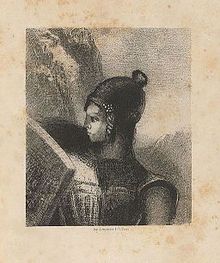
The plot revolves around a magic band that grants the power to rule the world, forged by the Nibelung dwarf Alberich from gold he stole from the Rhine maidens in the river Rhine. With the assistance of the god Loge, Wotan – the primary of the gods – steals the ring from Alberich, but is forced to hand information technology over to the giants Fafner and Fasolt in payment for building the domicile of the gods, Valhalla, or they will take Freia, who provides the gods with the golden apples that keep them immature. Wotan'south schemes to regain the ring, spanning generations, bulldoze much of the action in the story. His grandson, the mortal Siegfried, wins the ring by slaying Fafner (who slew Fasolt for the ring) – as Wotan intended – only is somewhen betrayed and slain as a result of the intrigues of Alberich's son Hagen, who wants the band for himself. Finally, the Valkyrie Brünnhilde – Siegfried's lover and Wotan'due south daughter who lost her immortality for defying her male parent in an endeavor to salve Siegfried'south father Sigmund – returns the ring to the Rhine maidens as she commits suicide on Siegfried's funeral pyre. Hagen is drowned equally he attempts to recover the ring. In the process, the gods and Valhalla are destroyed.
Details of the storylines can exist found in the manufactures on each music drama.
Wagner created the story of the Ring by fusing elements from many German and Scandinavian myths and folk-tales. The Old Norse Edda supplied much of the textile for Das Rheingold, while Die Walküre was largely based on the Völsunga saga. Siegfried contains elements from the Eddur, the Völsunga saga and Thidrekssaga. The final Götterdämmerung draws from the 12th-century German poem, the Nibelungenlied, which appears to accept been the original inspiration for the Ring.[v]
The Band has been the bailiwick of myriad interpretations. For example, George Bernard Shaw, in The Perfect Wagnerite, argues for a view of The Ring as an essentially socialist critique of industrial society and its abuses. Robert Donington in Wagner's Ring And Its Symbols interprets it in terms of Jungian psychology, as an account of the development of unconscious archetypes in the mind, leading towards individuation.
Concept [edit]
In his earlier operas (upward to and including Lohengrin) Wagner's mode had been based, rather than on the Italian style of opera, on the German language style as developed past Carl Maria von Weber, with elements of the grand opera style of Giacomo Meyerbeer. Nevertheless he came to exist dissatisfied with such a format as a ways of artistic expression. He expressed this clearly in his essay 'A Communication to My Friends', (1851) in which he condemned the bulk of mod artists, in painting and in music, as "feminine ... the world of fine art close fenced from Life, in which Fine art plays with herself.' Where however the impressions of Life produce an overwhelming 'poetic force', we notice the 'masculine, the generative path of Art'.[six]
Wagner unfortunately found that his audiences were not willing to follow where he led them:
The public, by their enthusiastic reception of Rienzi and their libation welcome of the Flying Dutchman, had plainly shown me what I must fix before them if I sought to please. I completely undeceived their expectations; they left the theatre, subsequently the first performance of Tannhäuser, [1845] in a confused and discontented mood. – The feeling of utter loneliness in which I now plant myself, quite unmanned me... My Tannhäuser had appealed to a handful of intimate friends lonely.[7]
Finally Wagner announces:
I shall never write an Opera more. As I have no wish to invent an arbitrary title for my works, I will phone call them Dramas ...
I advise to produce my myth in three complete dramas, preceded by a lengthy Prelude (Vorspiel). ...
At a specially-appointed Festival, I suggest, some future fourth dimension, to produce those iii Dramas with their Prelude, in the course of 3 days and a fore-evening. The object of this production I shall consider thoroughly attained, if I and my artistic comrades, the actual performers, shall within these four evenings succeed in artistically conveying my purpose to the truthful Emotional (not the Critical) Understanding of spectators who shall have gathered together expressly to learn it.[viii]
This is his first public announcement of the form of what would become the Ring bike.
In accordance with the ideas expressed in his essays of the menses 1849–51 (including the "Advice" but also "Opera and Drama" and "The Artwork of the Futurity"), the four parts of the Ring were originally conceived past Wagner to be complimentary of the traditional operatic concepts of aria and operatic chorus. The Wagner scholar Short von Westernhagen identified three important problems discussed in "Opera and Drama" which were specially relevant to the Band bicycle: the problem of unifying verse stress with melody; the disjunctions caused past formal arias in dramatic structure, and the way in which opera music could be organised on a different ground of organic growth and modulation; and the function of musical motifs in linking elements of the plot whose connections might otherwise be inexplicit. This became known as the leitmotif technique (run into below), although Wagner himself did non use this give-and-take.[9]
However, Wagner relaxed some aspects of his self-imposed restrictions somewhat equally the work progressed. Equally George Bernard Shaw sardonically (and slightly unfairly)[10] noted of the last opera Götterdämmerung:
And now, O Nibelungen Spectator, pluck upwardly; for all allegories come to an end somewhere... The residuum of what you lot are going to see is opera, and nothing merely opera. Before many bars have been played, Siegfried and the wakened Brynhild, newly become tenor and soprano, volition sing a concerted cadenza; plunge on from that to a magnificent beloved duet...The work which follows, entitled Dark Falls on the Gods [Shaw's translation of Götterdämmerung], is a thorough k opera.[11]
Music [edit]
Leitmotifs [edit]
Every bit a significant chemical element in the Ring and his subsequent works, Wagner adopted the use of leitmotifs, which are recurring themes or harmonic progressions. They musically denote an action, object, emotion, character, or other subject field mentioned in the text or presented onstage. Wagner referred to them in "Opera and Drama" as "guides-to-feeling", describing how they could be used to inform the listener of a musical or dramatic subtext to the action onstage in the same fashion as a Greek chorus did for the theatre of ancient Greece.
Instrumentation [edit]
Wagner made significant innovations in orchestration in this piece of work. He wrote for a very large orchestra, using the whole range of instruments used singly or in combination to limited the great range of emotion and events of the drama. Wagner even commissioned the production of new instruments, including the Wagner tuba, invented to fill a gap he found between the tone qualities of the horn and the trombone, likewise as variations of existing instruments, such as the bass trumpet and a contrabass trombone with a double slide. He also adult the "Wagner bell", enabling the bassoon to reach the low A-natural, whereas usually B-flat is the instrument'south lowest note. If such a bell is not to be used, then a contrabassoon should be employed.
All 4 parts accept a very similar instrumentation. The cadre ensemble of instruments are one piccolo, iii flutes (third doubling second piccolo), 3 oboes, cor anglais (doubling fourth oboe), three soprano clarinets, 1 bass clarinet, 3 bassoons; eight horns (fifth through eight doubling Wagner tubas), three trumpets, one bass trumpet, iii tenor trombones, i contrabass trombone (doubling bass trombone), one contrabass tuba; a percussion department with 4 timpani (requiring two players), triangle, cymbals, glockenspiel, tam-tam; vi harps and a cord section consisting of 16 first and 16 second violins, 12 violas, 12 cellos, and viii double basses.
Das Rheingold requires ane bass drum, 1 onstage harp and 18 onstage anvils. Die Walküre requires ane snare drum, ane D clarinet (played by the tertiary clarinettist), and an on-stage steerhorn. Siegfried requires one onstage cor anglais and one onstage horn. Götterdämmerung requires a tenor drum, likewise as v onstage horns and four onstage steerhorns, 1 of them to be blown past Hagen.
Tonality [edit]
Much of the Ring, peculiarly from Siegfried act three onwards, cannot be said to be in traditional, clearly defined keys for long stretches, but rather in 'key regions', each of which flows smoothly into the following. This fluidity avoided the musical equivalent of clearly divers musical paragraphs, and assisted Wagner in edifice the work's huge structures. Tonal indeterminacy was heightened past the increased freedom with which he used noise and chromaticism. Chromatically altered chords are used very liberally in the Band, and this characteristic, which is also prominent in Tristan und Isolde, is oft cited as a milestone on the fashion to Arnold Schoenberg'southward revolutionary break with the traditional concept of cardinal and his dissolution of consonance every bit the footing of an organising principle in music.
Limerick [edit]
The text [edit]
In summer 1848 Wagner wrote The Nibelung Myth every bit Sketch for a Drama, combining the medieval sources previously mentioned into a single narrative, very like to the plot of the eventual Band bike, but yet with substantial differences. Later that year he began writing a libretto entitled Siegfrieds Tod ("Siegfried's Death"). He was possibly stimulated by a series of articles in the Neue Zeitschrift für Musik, inviting composers to write a 'national opera' based on the Nibelungenlied, a 12th-century Loftier High german poem which, since its rediscovery in 1755, had been hailed by the High german Romantics as the "German national ballsy". Siegfrieds Tod dealt with the death of Siegfried, the central heroic figure of the Nibelungenlied. The thought had occurred to others – the correspondence of Fanny and Felix Mendelssohn in 1840/41 reveals that they were both outlining scenarios on the discipline: Fanny wrote 'The hunt with Siegfried's death provides a splendid finale to the second act'.[12]
Past 1850, Wagner had completed a musical sketch (which he abandoned) for Siegfrieds Tod.[ citation needed ] He now felt that he needed a preliminary opera, Der junge Siegfried ("The Immature Siegfried", afterwards renamed to "Siegfried"), to explain the events in Siegfrieds Tod, and his verse draft of this was completed in May 1851.[ citation needed ] Past October, he had made the momentous decision to embark on a cycle of four operas, to be played over four nights: Das Rheingold, Die Walküre, Der Junge Siegfried and Siegfrieds Tod; the text for all 4 parts was completed in December 1852, and privately published in Feb 1853.[ citation needed ]
The music [edit]
In November 1853, Wagner began the composition typhoon of Das Rheingold. Unlike the verses, which were written as information technology were in contrary order, the music would be equanimous in the same lodge as the narrative. Composition proceeded until 1857, when the final score upwards to the end of act two of Siegfried was completed. Wagner and so laid the work aside for twelve years, during which he wrote Tristan und Isolde and Die Meistersinger von Nürnberg.
By 1869, Wagner was living at Tribschen on Lake Lucerne, sponsored by Male monarch Ludwig 2 of Bavaria. He returned to Siegfried, and, remarkably, was able to pick upwards where he left off. In Oct, he completed the final work in the bicycle. He chose the title Götterdämmerung instead of Siegfrieds Tod. In the completed work the gods are destroyed in accord with the new pessimistic thrust of the cycle, not redeemed as in the more optimistic originally planned catastrophe. Wagner also decided to show onstage the events of Das Rheingold and Die Walküre, which had hitherto only been presented every bit back-narration in the other two parts. These changes resulted in some discrepancies in the cycle, merely these do non diminish the value of the work.
Performances [edit]
First productions [edit]

Amalie Materna, the first Bayreuth Brünnhilde, with Cocotte, the horse donated by King Ludwig to play her equus caballus Grane
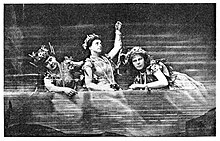
On King Ludwig's insistence, and over Wagner'due south objections, "special previews" of Das Rheingold and Die Walküre were given at the National Theatre in Munich, before the residue of the Ring. Thus, Das Rheingold premiered on 22 September 1869, and Dice Walküre on 26 June 1870. Wagner afterward delayed announcing his completion of Siegfried to prevent this work likewise being premiered against his wishes.
Wagner had long desired to have a special festival opera house, designed by himself, for the operation of the Band. In 1871, he decided on a location in the Bavarian boondocks of Bayreuth. In 1872, he moved to Bayreuth, and the foundation rock was laid. Wagner would spend the next 2 years attempting to raise capital letter for the construction, with scant success; King Ludwig finally rescued the project in 1874 by donating the needed funds. The Bayreuth Festspielhaus opened in 1876 with the offset consummate performance of the Ring, which took place from thirteen to 17 Baronial.
In 1882, London impresario Alfred Schulz-Curtius organized the outset staging in the U.k. of the Ring cycle, conducted by Anton Seidl and directed past Angelo Neumann.[13]
The commencement product of the Ring in Italia was in Venice (the place where Wagner died), but two months after his 1883 expiry, at La Fenice.[14]
The offset Australasian Ring (and The Mastersingers of Nuremberg) was presented by the Thomas Quinlan visitor Melbourne and Sydney in 1913.
Modern productions [edit]
The Ring is a major undertaking for any opera company: staging four interlinked operas requires a huge delivery both artistically and financially; hence, in nearly opera houses, production of a new Ring cycle will happen over a number of years, with one or two operas in the cycle existence added each year. The Bayreuth Festival, where the complete cycle is performed most years, is unusual in that a new cycle is almost always created within a single year.
Early on productions of the Ring cycle stayed shut to Wagner's original Bayreuth staging. Trends set at Bayreuth have connected to be influential. Following the closure of the Festspielhaus during the Second World War, the 1950s saw productions by Wagner's grandsons Wieland and Wolfgang Wagner (known as the 'New Bayreuth' manner), which emphasised the human aspects of the drama in a more than abstract setting.[15]
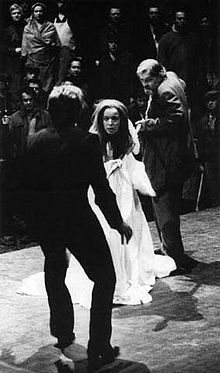
Perhaps the well-nigh famous modern product was the centennial production of 1976, the Jahrhundertring, directed by Patrice Chéreau and conducted by Pierre Boulez.[16] Set in the industrial revolution, it replaced the depths of the Rhine with a hydroelectric power dam and featured grimy sets populated by men and gods in 19th and 20th century business suits. This drew heavily on the reading of the Ring equally a revolutionary drama and critique of the modern world, famously expounded past George Bernard Shaw in The Perfect Wagnerite. Early performances were booed but the audience of 1980 gave it a 45-infinitesimal ovation in its terminal yr.[17] [xviii]
Seattle Opera has created three unlike productions of the tetralogy: Band 1, 1975 to 1984: Originally directed past George London, with designs by John Naccarato following the famous illustrations by Arthur Rackham. Information technology was performed twice each summer, in one case in German, once in Andrew Porter's English adaptation. Henry Holt conducted all performances. Ring 2, 1985–1995: Directed by Francois Rochaix, with sets and costumes designed by Robert Israel, lighting by Joan Sullivan, and supertitles (the first ever created for the Band) by Sonya Friedman. The product set the activity in a world of nineteenth-century theatricality; it was initially controversial in 1985, it sold out its last performances in 1995. Conductors included Armin Jordan (Dice Walküre in 1985), Manuel Rosenthal (1986), and Hermann Michael (1987, 1991, and 1995). Ring iii, 2000–2013: the production, which became known every bit the "Light-green" Ring, was in part inspired by the natural beauty of the Pacific Northwest. Directed by Stephen Wadsworth, set designer Thomas Lynch, costume designer Martin Pakledinaz, lighting designer Peter Kaczorowski; Armin Hashemite kingdom of jordan conducted in 2000, Franz Vote in 2001, and Robert Spano in 2005 and 2009. The 2013 performances, conducted past Asher Fisch, were released as a commercial recording on compact disc and on iTunes.[19]
In 2003 the get-go production of the cycle in Russia in modernistic times was conducted past Valery Gergiev at the Mariinsky Opera, Saint Petersburg, designed by George Tsypin. The production drew parallels with Ossetian mythology.[20]
The Royal Danish Opera performed a complete Ring cycle in May 2006 in its new waterfront dwelling house, the Copenhagen Opera House. This version of the Ring tells the story from the viewpoint of Brünnhilde and has a distinct feminist angle. For example, in a key scene in Die Walküre, it is Sieglinde and non Siegmund who manages to pull the sword Nothung out of a tree. At the end of the cycle, Brünnhilde does non die, but instead gives birth to Siegfried's kid.[21]
San Francisco Opera and Washington National Opera began a co-production of a new cycle in 2006 directed past Francesca Zambello. The production uses imagery from diverse eras of American history and has a feminist and environmentalist viewpoint. Recent performances of this production took place at the John F. Kennedy Eye for the Performing Arts in Washington D.C. in April/May 2016, featuring Catherine Foster and Nina Stemme as Brünnhilde, Daniel Brenna as Siegfried, and Alan Held as Wotan.[22]
Los Angeles Opera presented its first Ring cycle in 2010 directed past Achim Freyer.[23] Freyer staged an abstract product that was praised by many critics but criticized by some of its own stars.[24] The production featured a raked stage, flying props, screen projections and special effects.

Modern costuming shown in endmost bows following Siegfried in 2013 at the Bavarian State Opera in Munich

Modernistic costuming shown in closing bows following Götterdämmerung in 2013 at the Bavarian State Opera. Left to right: Gunther, the Rhinemaidens, Gutrune, Hagen, Brünnhilde, Siegfried
The Metropolitan Opera began a new Band wheel directed by French-Canadian theater director Robert Lepage in 2010. Premiering with Das Rheingold on opening nighttime of the 2010/2011 Flavor conducted past James Levine with Bryn Terfel as Wotan. This was followed by Die Walküre in April 2011 starring Deborah Voigt. The 2011/12 season introduced Siegfried and Götterdämmerung with Voigt, Terfel, and Jay Hunter Morris before the entire cycle was given in the Leap of 2012 conducted by Fabio Luisi (who stepped in for Levine due to health bug). Lepage's staging was dominated past a 90,000 pound (40 tonne) structure which consisted of 24 identical aluminium planks able to rotate independently on a horizontal axis across the stage, providing level, sloping, angled or moving surfaces facing the audience. Bubbles, falling stones and fire were projected on to these surfaces, linked past computer with the music and movement of the characters. The subsequent HD recordings in 2013 won the Met's orchestra and chorus the Grammy Award for Best Opera Recording for their performance.[25] In 2019, the Metropolitan Opera revived the Lepage staging for the first time since 2013 with Philippe Jordan conducting, Greer Grimsley and Michael Volle rotating equally Wotan, Stefan Vinke and Andreas Schager rotating equally Siegfried, and Met homegrown Christine Goerke as Brünnhilde. Lepage's "Automobile", every bit information technology affectionately became known, underwent major reconfiguration for the revival in guild to dampen the creaking that it had produced in the past (to the annoyance of audience members and critics) and to improve its reliability, as it had been known to suspension down during before runs including on the opening night of Rheingold.[26] [27] [28]
Opera Australia presented the Ring cycle at the State Theatre in Melbourne, Commonwealth of australia, in November 2013, directed by Neil Armfield and conducted by Pietari Inkinen. Classical Voice America heralded the production as "i of the best Rings anywhere in a long time."[29] The production was presented over again in Melbourne from 21 Nov to 16 December 2016 starring Lise Lindstrom, Stefan Vinke, Bister Wagner and Jacqueline Dark.[30]
It is possible to perform The Band with fewer resources than usual. In 1990, the Metropolis of Birmingham Touring Opera (now Birmingham Opera Company), presented a 2-evening adaptation (by Jonathan Pigeon) for a limited number of solo singers, each doubling several roles, and eighteen orchestral players.[31] This version was subsequently given productions in the The states.[32] A heavily cut-downward version (7 hours plus intervals) was performed at the Teatro Colón in Buenos Aires on 26 November 2012 to mark the 200th ceremony of Wagner's nascency.[33]
In a unlike approach, Der Ring in Minden staged the wheel on the minor phase of the Stadttheater Minden, beginning in 2015 with Das Rheingold, followed by the other parts in the succeeding years, and culminating with the complete cycle performed twice in 2019. The stage director was Gerd Heinz, and Frank Beermann conducted the Nordwestdeutsche Philharmonie, playing at the back of the phase. The singers acted in front of the orchestra, making an intimate approach to the dramatic situations possible. The project received international recognition.[34] [35]
Recordings of the Ring cycle [edit]
Other treatments of the Ring cycle [edit]
Orchestral versions of the Ring bicycle, summarizing the work in a single movement of an hour or so, take been made by Leopold Stokowski, Lorin Maazel (Der Ring ohne Worte) (1988) and Henk de Vlieger (The Ring: an Orchestral Run a risk), (1991).[36]
English-Canadian comedian and singer Anna Russell recorded a twenty-2-minute version of the Ring for her album Anna Russell Sings! Over again? in 1953, characterized by camp sense of humour and sharp wit.[37]
Produced by the Ridiculous Theatrical Company, Charles Ludlam's 1977 play Der Ring Gott Farblonjet was a spoof of Wagner'south operas. The show received a well-reviewed 1990 revival in New York at the Lucille Lortel Theatre.[38]
In 1991, Seattle Opera premiered a musical comedy parody of the Ring Bicycle called Das Barbecü, with book and lyrics by Jim Luigs and music past Scott Warrender. It follows the outline of the cycle'south plot just shifts the setting to Texas ranch country. Information technology was later produced off-broadway and elsewhere effectually the earth.
The German ii-part television movie Dark Kingdom: The Dragon King (2004, also known as Ring of the Nibelungs, Die Nibelungen, Curse of the Ring and Sword of Xanten), is based in some of the same cloth Richard Wagner used for his music dramas Siegfried and Götterdämmerung .
An accommodation of Wagner'due south storyline was published every bit a graphic novel in 2018 by P. Craig Russell.[39]
References and notes [edit]
- ^ "Wagner – Ring Wheel". Archetype FM. 2020. Retrieved 12 September 2020.
- ^ von Rhein, John (21 September 2016). "An epic beginning for Lyric'south new Wagner 'Ring' cycle". Chicago Tribune . Retrieved 17 June 2017.
- ^ Magee 2001, p. 109.
- ^ "Wagner in Russia: Ringing in the century". The Economist. 12 June 2003. Retrieved 20 September 2018.
- ^ For a detailed examination of Wagner'south sources for the Band and his treatment of them, see, among other works, Deryck Cooke's unfinished report of the Ring, I Saw the Earth Stop Cooke (2000), and Ernest Newman'due south Wagner Nights. Also useful is a translation by Stewart Spencer (Wagner's 'Band of the Nibelung': Companion, edited past Barry Millington) which, every bit well as containing essays, including i on the source cloth which provides an English translation of the entire text that strives to remain faithful to the early medieval Stabreim technique Wagner used.
- ^ Wagner (1994), p. 287.
- ^ Wagner (1994), pp. 336–337.
- ^ Wagner (1994), p. 391 and n..
- ^ Burbidge & Sutton (1979), pp. 345–346.
- ^ Millington (2008), p. 80.
- ^ Shaw (1898), section: "Back to Opera Again".
- ^ Alphabetic character of ix December 1840. See Mendelssohn (1987), pp. 299–301
- ^ Fifield (2005), pp. 25–26.
- ^ Boydell and Brewer (2 December 2008). "From Beyond the Stave: The Panthera leo roars for Wagner". Frombeyondthestave.blogspot.com . Retrieved 29 Apr 2017.
- ^ "Productions – Wieland Wagner, New Bayreuth". Wagner Operas. 3 March 2012. Retrieved 29 Apr 2017.
- ^ "The 1976 Bayreuth Centennial Band", Wagneropera.com, retrieved 2 December 2011
- ^ Kozinn, Allan (7 Oct 2013). "Patrice Chéreau, Opera, Phase and Moving picture Director, Dies at 68". The New York Times . Retrieved eight October 2013.
- ^ Millington, Barry (viii Oct 2013). "Patrice Chéreau and the bringing of dramatic conviction to the opera house". The Guardian. London. Retrieved 11 October 2013.
- ^ Band performances, Seattle Opera
- ^ "Mariinsky Theatre brings Band Wheel to Covent Garden in Summer 2009", Musicalcriticism.com ane March 2009, retrieved 1 December 2011
- ^ "Archived copy". Archived from the original on 26 Apr 2012. Retrieved 3 December 2011.
{{cite web}}: CS1 maint: archived copy as title (link) - ^ "Ring Cycle". John F. Kennedy Middle for the Performing Arts. 22 May 2016. Retrieved 29 April 2017.
- ^ Diane Haithman (15 February 2009). "Achim Freyer is consumed by The Ring of the Nibelung". Los Angeles Times . Retrieved 29 April 2017.
- ^ Adams, Guy (15 May 2010). "Wagner star and director clash in U.s. costume drama". The Independent . Retrieved 29 April 2017.
- ^ "55th Almanac Grammy Awards Nominees: Classical". Grammy.com . Retrieved 10 February 2013.
- ^ "Everything You Need to Know About the Met Opera'due south 2018-19 Revival of Wagner's Band Bike – Opera Wire". operawire.com. 15 February 2018.
- ^ Goodwin, Jay (7 March 2019). "The Met Opera Revives Robert LePage'due south Hi-Tech Staging of Wagner'due south Ring Cycle". Playbill.
- ^ Cooper, Michael (21 September 2018). "Retooling the Met Opera's Problematic Band Motorcar". The New York Times.
- ^ "Bedeviled Ring Seemed Doomed, And so Curtain Rose". Classicalvoiceamerica.org. 14 December 2013. Retrieved 29 April 2017.
- ^ "Information technology'southward a Wrap: The Melbourne Ring". Classic Melbourne. 21 December 2016. Retrieved 23 August 2017.
- ^ "The Ring Saga". birminghamopera.org.britain. 2013. Archived from the original on five March 2016. Retrieved v August 2013.
- ^ Croan, Robert (18 July 2006). "Opera Review: Abridged staging of archetype Wagner cycle rings true – Pittsburgh Post-Gazette". post-gazette.com . Retrieved 5 Baronial 2013.
- ^ Samira Schellhaaß (27 September 2012). "The Ring in Teatro Colón". Deutsche Welle. Retrieved 17 Jan 2016.
- ^ Oehrlein, Josef (27 September 2019). "Der Kleine muss Ideen haben / Zeitreise durch vier Epochen: Richard Wagners "Ring" in Minden". Frankfurter Allgemeine Zeitung (in German). Frankfurt. Retrieved 6 September 2019.
- ^ Brockmann, Sigi (eight October 2019). "Minden / Stadttheater: Der Band des Nibelungen – jetzt das gesamte Bühnenfestspiel". Der Neue Merker (in German). Retrieved 13 September 2017.
- ^ www.schott-music.com http://arquivo.pt/wayback/20160514161037/http://www.schott-music.com/news/archive/show,6714.html. Archived from the original on fourteen May 2016.
- ^ "Anna Russell'south Ring".
- ^ Gussow, Mel (thirteen Apr 1990). "'Der Band Gott Farblonjet:' review". The New York Times.
- ^ Russell, P. Craig (2018). The Ring of the Nibelung. Milwaukie, Oregon: Night Horse Books. ISBN978-1-50670-919-2.
Sources [edit]
- Burbidge, Peter; Sutton, Richard (1979). The Wagner Companion. London. ISBN0571114504.
- Cooke, Deryck (2000). I Saw the World Stop: A Report of Wagner'due south Ring. New York: Oxford Academy Press. ISBN0193153181.
- Fifield, Christopher (2005). Ibbs and Tillett: The Rise and Autumn of a Musical Empire. London: Ashgate. ISBN978-1840142907.
- Magee, Bryan (2001). The Tristan chord: Wagner and Philosophy. Metropolitan Books. ISBN0805067884.
- Mendelssohn, Fanny (1987). Marcia Citron (ed.). Letters of Fanny Hensel to Felix Mendelssohn. Pendragon Press. ISBN978-0-918728-52-4.
- Millington, Barry (2008). "Der Band des Nibelungen: conception and interpretation". In Grey, Thomas S. (ed.). The Cambridge Companion to Wagner. Cambridge Companions to Music. Cambridge University Press. pp. 74–84. ISBN978-0521644396.
- Shaw, George Bernard (1898). The Perfect Wagnerite . Retrieved 29 April 2017 – via Project Gutenberg.
- Wagner, Richard (1994). The Art Piece of work of the Future, and other works ("A Advice to My Friends" is on pp. 269–392.). Translated by William Ashton Ellis. Lincoln and London. ISBN978-0803297524.
Further reading [edit]
- Besack, Michael, The Esoteric Wagner – an introduction to Der Ring des Nibelungen, Berkeley: Regent Printing, 2004 ISBN 9781587900747.
- Di Gaetani, John Louis, Penetrating Wagner'south Band: An Anthology. New York: Da Capo Press, 1978. ISBN 9780306804373.
- Gregor-Dellin, Martin, (1983) Richard Wagner: His Life, His Piece of work, His Century. Harcourt, ISBN 0151771510.
- Holman, J. K. Wagner's Band: A Listener'southward Companion and Concordance. Portland, Oregon: Amadeus Press, 2001.
- Lee, Thousand. Owen, (1994) Wagner's Ring: Turning the Sky Round. Amadeus Press, ISBN 9780879101862.
- Magee, Bryan, (1988) Aspects of Wagner. Oxford University Press, ISBN 0192840126.
- May, Thomas, (2004) Decoding Wagner. Amadeus Press, ISBN 9781574670974.
- Millington, Barry (editor) (2001) The Wagner Compendium. Thames & Hudson, ISBN 0500282749.
- Sabor, Rudolph, (1997) Richard Wagner: Der Ring des Nibelungen: a companion volume. Phaidon Press, ISBN 0714836508.
- Scruton, Sir Roger, (2016) The Ring of Truth: The Wisdom of Wagner'southward Band of the Nibelung. Penguin United kingdom of great britain and northern ireland, ISBN 1468315498.
- Spotts, Frederick, (1999) Bayreuth: A History of the Wagner Festival. Yale University Press ISBN 0712652779.
External links [edit]
- Anthony Tommasini (21 July 2007). "The 'Kirov' Ring: Let's Hear Information technology for the Home Team". The New York Times . Retrieved 10 July 2020.
- "Radio Lab – The Ring and I". WNYC – A podcast about The Ring. 2004.
Source: https://en.wikipedia.org/wiki/Der_Ring_des_Nibelungen
Posted by: adandiffeclus.blogspot.com
0 Response to "Ring Of The Nibelungs Watch Online"
Post a Comment